Research from the archives
From time to time Simon Mathieson delves into the archives
and comes up with something from Oysterband's history.
Research and opinions all his own!
OYSTERBAND ALBUMS - a fan's view
Folk Roots April 1986 feature
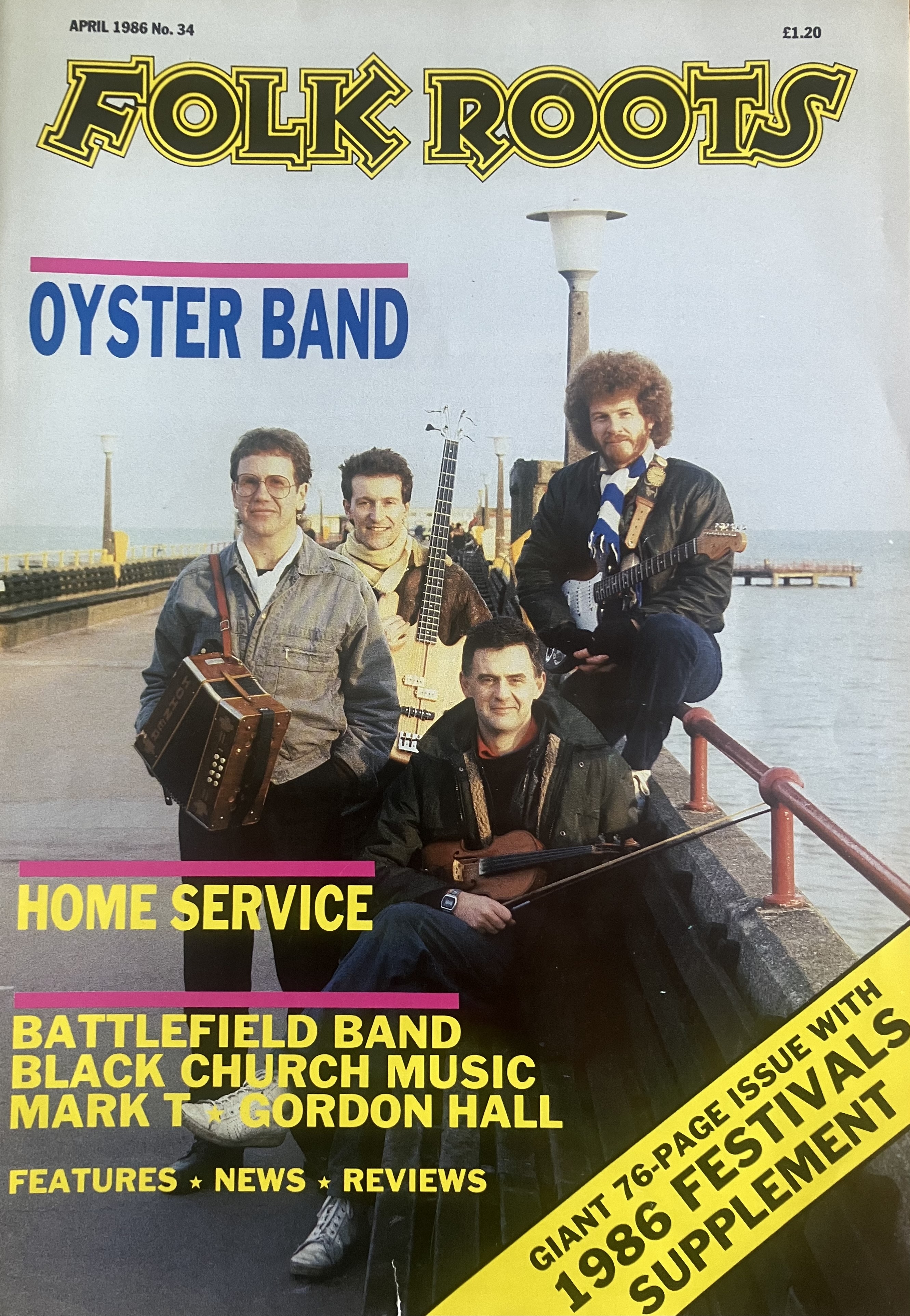
Simon says: " In April 1986 Folk Roots magazine carried a feature on The Oyster Band, including an interview with the editor Ian A Anderson. The article portrays a fascinating time for the band, on the cusp of moving away from folk clubs and ceilidhs. It shows the band preparing to find the direction they wanted to go in and the build up to making their first Cooking Vinyl release, Step Outside."
The article reminded us, that once upon a time, there was a very large outfit called the Oyster Ceilidh Band (and even that was a shortened name) who did the time-honoured circuit of P.T.A. and folk festival barn dances. They did these whilst evolving a unique and skilled improvisational style, breathing unsuspected life into English country dance tunes. They included the refugees from a certain band who'd woken up one day (some time after they'd generally ceased to exist) to find themselves joining the ranks of one-hit-wonders with a catchy little ditty about a day trip to a town in North Wales.
The original seven-piece recorded the 1980 debut LP Jack's Alive for Dingles, then shortened their name further and pared down to a quintet for 1982's English Rock & Roll - The Early Years 1800-1850. Original vocalist Cathy Lesurf guested on that one, although she'd already left for the Albion Band. After this, John Jones took over the lead vocal chores for the subsequent Lie Back and Think of England and Liberty Hall (in between which they put out their dance tune album 20 Golden Tie-Slackeners). By the time of 1985's Liberty Hall (like all but their first, on their own Pukka Records label), they'd successfully completed the transformation into a primarily song / concert band and streamlined into the quartet of Alan Prosser (guitar, vocals), lan Kearey (bass, vocals), John Jones (vocals, melodeon) and Ian Telfer (violin, sax, keyboards).
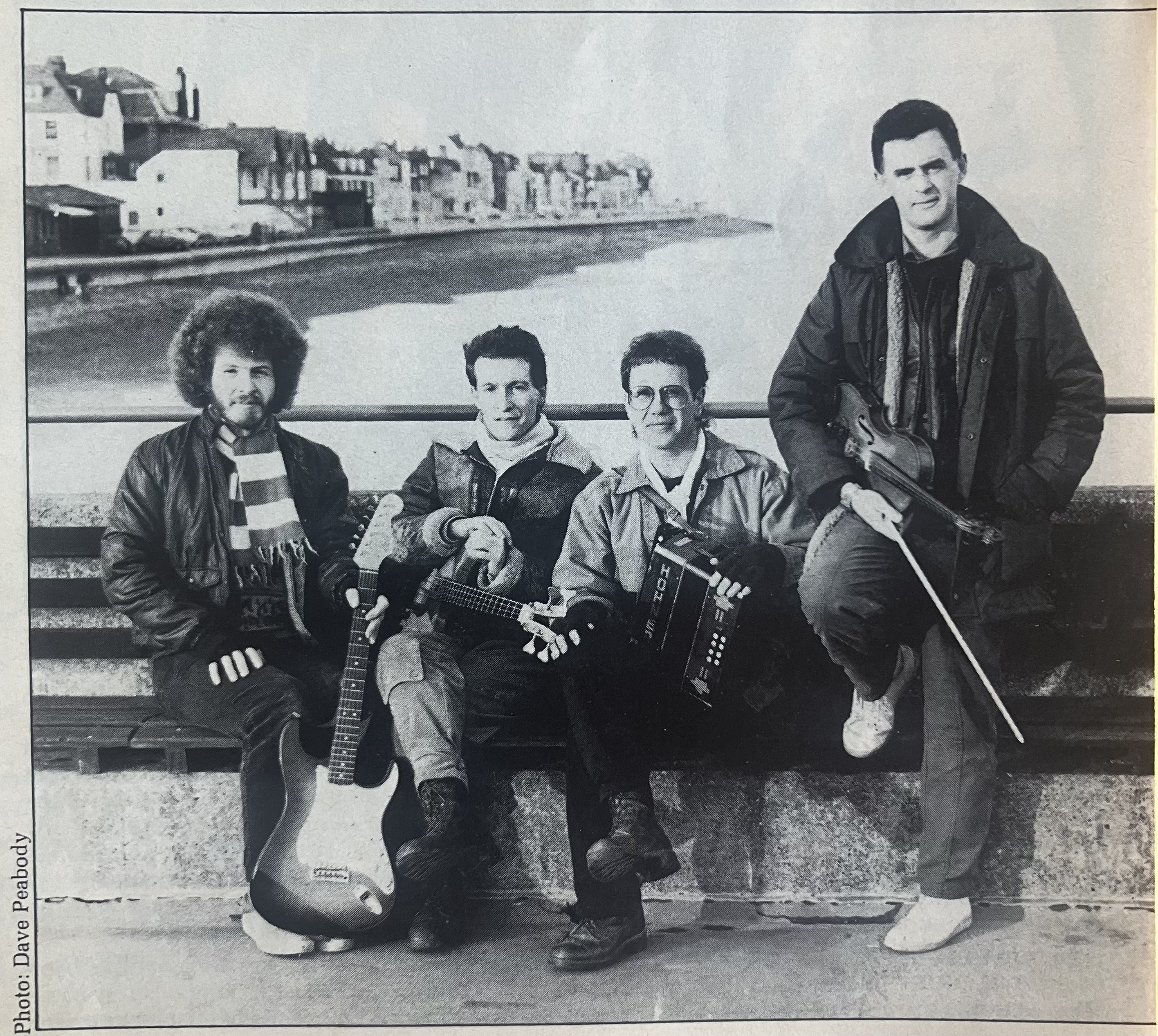
It had been three years since Folk Roots had last interviewed the Oysters, and they started by reflecting on the changes over that period. John Jones described where the band were in this early part of 1986: “I think this year, for the first time, the concert work is about 60% to 70% which is as we want it to be. We've enjoyed being a dance band; and we still do. We enjoy the ceilidhs, it's still great fun, but being a concert band, a song band, now is the bigger challenge.”
Three years earlier, the band had been debating whether to throw themselves totally into doing a record of original songs, or surreptitiously to increase the number of original songs per record, which is the course they took. The question was asked if that was a great debate within the band members, or did it just seem to happen?
John Jones and Ian Kearey both suggested that it had not only been a debate but still was the cause of much discussion. John went on to say: “The mixing of the two is a very difficult balance. We not only discuss for an album the number of tracks that might be traditional and the number that might be original, but the sort of things that might fit together. One or two people have said, and I'm sure they're trying to be nice, that you can't tell which are the traditional and which are the original ones.”
The band acknowledged that they’d had some of their biggest discussions during this time over the material to feature. Moving further away from the traditional material could have found them with four very different versions as to where the band was going. Being good friends and having worked together for some time, were the reasons discussed for why an agreement was found.
Alan Prosser explained: “Everything developed fairly logically until we hit our own songwriting and then, because we wanted the lyrics of the songs to be so good, we hit a lot of snags there. We were trying to compose words that we could all agree on.”
Ian Telfer summed this process up in his usual succinct way describing a process of looking at draft lyrics and going: “No, no, no and occasionally yes.”
As the band considered their new approach in songwriting, there was clearly a concern about what audience they might find were out there for them. John described this: “I do feel that if we're going to find a wider audience, and we need to find a wider audience as every band does eventually, then we've got to try to make it more accessible. If you're going to write your own songs and evolve a form of music that comes from traditional forms but satisfies you now, then for us it can only be quite a complex product. The songs that we're working on at the moment have got to satisfy all the individuals within the band, but I think that when it comes to recorded music it's a question of keeping the sounds separate and keeping the instrumentation down. We've very often layered and layered to build up a really deep, thick texture, and very often simple lines can get lost in it. Part of this also is drums, because drums do simplify things.”
The debate about whether the band needed to have a drummer was also explored in the article. Russell Lax was to join not long afterwards and he played on Step Outside, offering a new dynamic to the sound. Ian Telfer tried to summarise the debate: “Don't underestimate what the cost of working without drums is for a band that's heavily dependent on instrumental skill, as well as having someone who can sing. It means that you've set yourself a very difficult task in terms of timekeeping and in terms of trying to make a physical impact on an audience if you're playing a large venue. These are things that have to be seriously considered.”
Clive Gregson was brought in to produce Step Outside but this wasn’t necessarily agreed as an approach at the time of this interview. Ian Kearey certainly felt it would be very useful, and Alan could see that it might help the band settle on a style. John agreed and said that he felt it was overdue for them to bring in someone external.
Even in 1986, the band’s appetite for touring could be seen. Ian Kearey outlined the plans for heading to Italy in March and then on to Germany. This was also the era of British Council tours and in the autumn of 1986 the band were going to India, Bangladesh and Sri Lanka.
The change of approach was also being seen in the change of the work the band was getting. As 1985 started, the band wanted to be doing fewer ceilidhs and fewer clubs. The band enjoyed them but needed to find different venues and different audiences. John acknowledged that this had started to happen and it was becoming more important to them to branch out, finding those new fans.
With a nod to that Fiddler’s Dram hit, Ian A Anderson asked what else the band might like to get into. Ian Telfer described his optimum route to further success: “What you want is a much smaller hit that actually leads on a step from what you already do and the people you already do it with.” John expanded by saying: “Having some sort of success with a single is the one sure way of actually bringing yourself to people's attention. At the moment we can't reach them through the existing channels that folk has.”
Despite this, the band recognised that making folk music more accessible was an aspiration. Other artists such as Billy Bragg, The Pogues and The Boothills were starting to make some progress.
John explored this further: “I think that the interest and intrigue, the fascination that folk music has for people who are not used to folk music in its widest sense, is that very simple primary reaction to the rhythms and the sounds. The sound particularly first got me interested - the weirdness, the magic.”
The interview ended by coming back to that sense that this was a band just starting to find a path for themselves. John opened up on this: “To my mind, I think the band is now actually facing its biggest challenge, that of creating its own music, making up tunes and also the songs. We had our first discussion about which direction the band ought to go in the pub about a fortnight ago, because we've never had to do this before.”
As a later interview in the same magazine in 1990 showed, the choices made from the pub discussions were clearly working for the band. Clive Gregson’s knowledge of what a rock band should sound like, adding a drummer to reduce the complexity of the band’s sound whilst adding extra energy and an increase in touring all meant that the band were becoming a real force on the music scene.
Folk Roots Jan/Feb 1990 feature
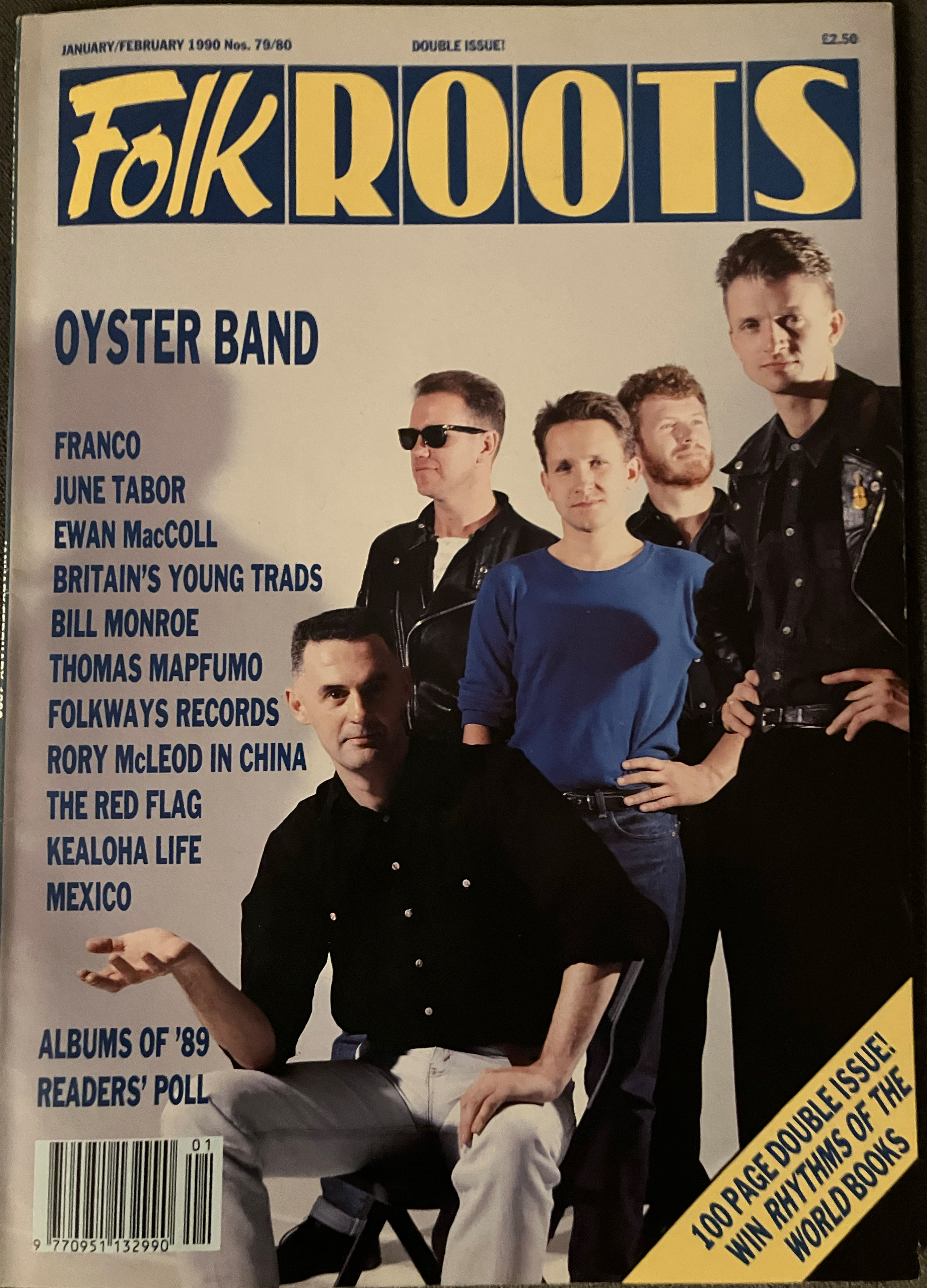
Simon says: "Sarah Coxson had a chat with the band and I have put together some of the highlights from that article."
Turning the clock back a little, one of the most important factors of change over the last few years has been the enrolment of Russell Lax on drums. Bringing him on board, according to John Jones, was the key element in reducing the complexity of the band's intrinsic sound but also adding that extra rhythm and energy.
"We used to play some good music - it had layers of harmony and was really nice but what it didn't have was that drive that I think is inherent in the music. Irish music changes for me when you add the bodhran. When percussion of any kind joins in and underpins something, it whacks it home."
It was at this stage, though, that everyone in the band had to simplify their role to a certain extent. In particular, it must have been difficult for lan Kearey, whose improvisatory bass style that had evolved through being in a band without a drummer for so long and who seemed restricted in this new context.
"I can remember feeling at the time when we made Step Outside that Clive Gregson's knowledge of what a rock band should sound like was invaluable but at the same time very challenging, very difficult to take on board because we had a very free-and-easy, anarchical style. But once you start to build up this sound picture that's like rock music, people have to restrict their roles to a certain extent anyway.
Given that we rushed into Step Outside, rushed into being this form of The Oyster Band, rushed Russell into playing with us with the idea that we'd just make a record with him and suddenly he was part of the band, we all did amazingly well - but it was very fraught. For Russell, coming in and trying to play songs that had been arranged without him, and also for Ian Kearey, I think it was very, very difficult. Clive is a consumate musician and had strong opinions as to how things should go. I think it's to everybody's credit that we actually made it work. It could have easily fallen apart."
But with an increase in touring, the stakes constantly going up meant that the personal pressure on members of the band eventually took its toll. After their Autumn '88 tour, Kearey decided he could no longer continue playing with the band and left.
The gaping hole was eventually filled by the talents of Chopper. And however much I may be a fan of Kearey's style, a great cohesion exists between Chopper and Russell. They're a really tight unit and Russell seems to have expanded his rhythmic vocabulary further.
Maybe the worldwide musical knowledge that Chopper can lay claim to has broadened his inventive horizons.
Telfer points this quality out. "What Chopper's brought to us amongst other things is his very wide experience of different kinds of dance music. People who know a lot more about South African dance music than I do can pick up on the slight overtone of mbaqanga or whatever it is that the boy throws in. Obviously it's not an attempt to imitate that kind of thing, it's just a familiarity with a very sophisticated range of dance feel.
That's been all to the good."
Jones is certainly pleased with the apparent simplification, with everyone playing less and achieving a more accurate live sound in the studio.
"It's less hurried and less frantic. The whole attack that we had before, which was quite exciting, went over the top. It was really confusing for people sometimes, you know. It's taken us a long time to get used to creating energy on stage without those layers and layers of busyness piling up."
———
Previous worries about how roots music would be accepted are now well and truly dismissed, as Ian Telfer recalls.
"There was a moment, wasn't there, where we nearly seriously misled ourselves and thought we had to turn ourselves into a guitar band and get in another guitarist. Oh, and am I glad that we didn't - what a horrible mistake. Who wants to be a third rate R.E.M. when you can be a first rate Oyster Band?"
Chopper: "What attracted me when I first joined the band was actually the sound of the fiddle and the squeezebox."
Russell: "Yeah, same with me. It was something they wanted to bury and something that we thought was the main feature of the band."
Ian: "Now, of course, I see that you were absolutely right."
Russell: "Of course!"
John: "We bloody didn't at the time!"
Ian: "I have no embarrassment about it at all now. I mean, I would take this band into almost any venue in the known universe."
Problems with presenting themselves as a serious, fully-fledged alternative group to the entire universe have also been over-come. Although their background of playing for dances for years was a very good training for playing and improvising, it hasn't necessarily been an awfully good schooling for going out and being completely extrovert on a stage.
Telfer dates the loss of self-consciousness to a particular week in July '88 when playing at a festival in West Berlin.
"On about the third day of that festival - we did five days in the same place - something suddenly clicked into place like a bone and we lost a certain kind of embarrassment, an innate embarrassment, an under-the-counter embarrassment, about what we were doing and began to say well, hell, it's the only chance we have to do it, let's do it.”
————
So the 1980s have marked a very long and definite transition for The Oyster Band. The BBC2 TV Rhythms Of The World series which will be featuring The Oyster Band on February 18th juxtaposes shots of the band playing in a village hall with them playing at Kentish Town's Town & Country. They've moved from the small, informal village hall ceilidh atmosphere to the big stage. Their music has even been heard in a recent edition of East Enders!
As John puts it:- "We've seen the music that has totally absorbed Ian and I for a good many years, twelve years and the rest, become fashionable." Telfer: "And it's become open-ended again, become capable of new development and growths."
Jones: "It could go back to everybody playing in village halls and little hops in clubs again, it could become the biggest thing since sliced bread. And in summing up a decade, which is bloody difficult, I'm told one of best things at Glastonbury '89 was when the Waterboys had Seamus Begley and Steve Cooney open for them. To get a terrific reaction for a melodeon and guitar duo at what is a major rock festival, to have the Mean Fiddler putting on a far more folky, rootsy bill at Reading than ever before, things have moved a hell of a way."
Telfer: "I like the way this coincides with some of the stirrings of political hope in this country. At the very end of the decade then perhaps the log jam might just shift, y'know. It's probably a coincidence but I find it a very pleasing one, a hopeful one."
Jones: "We'll all be glad when the Labour Party are re-elected and we can go back to writing real songs.””